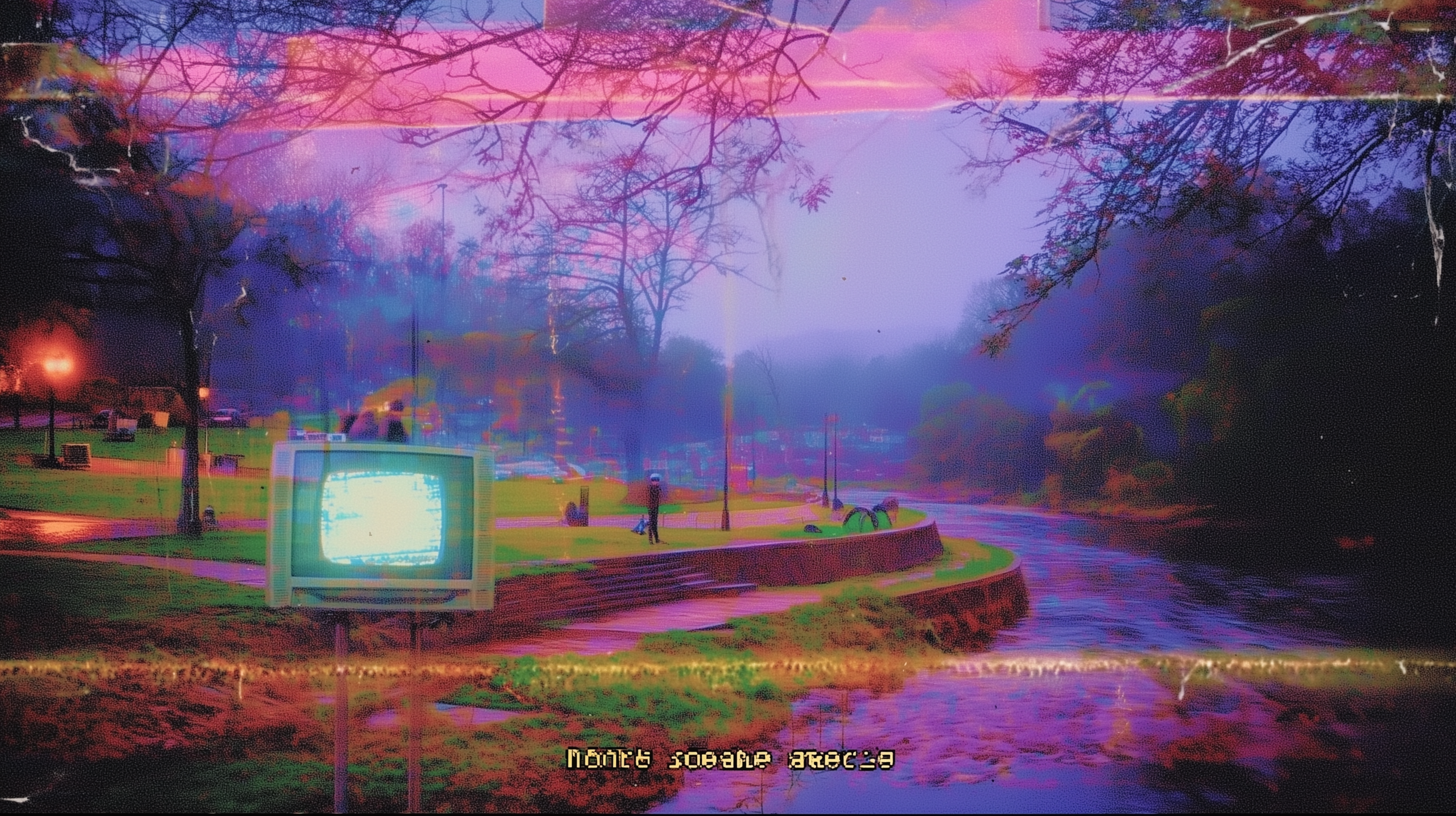
Relief Valve
Relief Valve is an interactive installation that visualizes nostalgia as a mass-produced emotional buffer in the age of acceleration and AI.
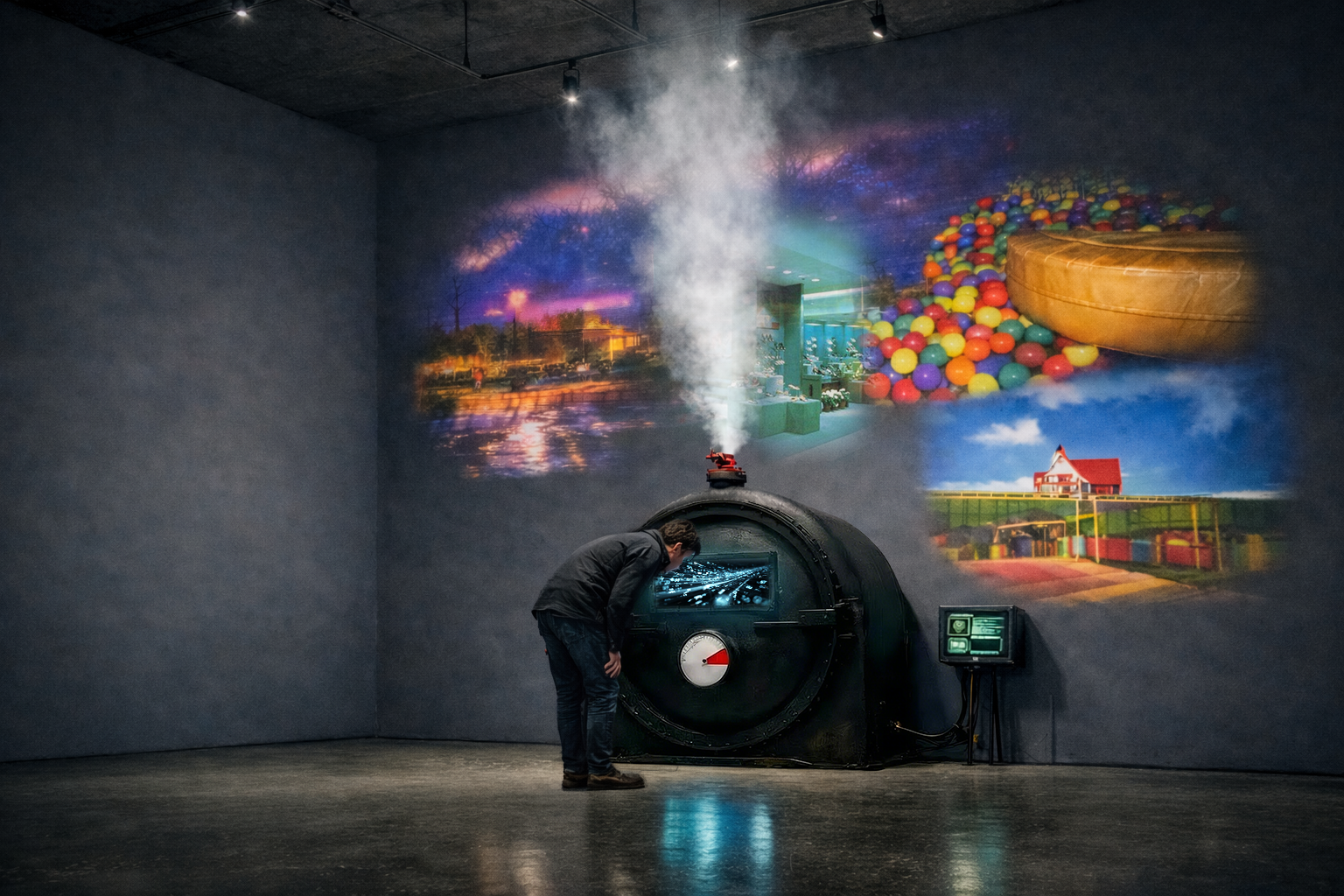
At its center stands an industrial pressure tank that accumulates real-time data about contemporary speed, anxiety, and information overload. As “pressure” rises, the system releases bursts of projected images and sound — not steam — forming fleeting nostalgic landscapes composed of real archival photographs and AI-generated pseudo-memories.
Relief Valve turns an invisible psychological coping loop into a visible machine — asking what happens when comfort itself becomes automated.
Project Proposal for the Residency
Concept Overview
I plan to develop an installation titled Relief Valve during the residency, exploring how people under contemporary acceleration and information overload use nostalgia as an emotional buffer—and how, in the age of AI, that nostalgia itself can be mass-produced. At the centre is an industrial pressure tank that turns an invisible psychological loop into a visible system: as real-time data representing the “speed” of the modern world accumulates and pressure rises, the safety valve opens, releasing not steam but a burst of images and sound—mixed from real photographs and AI-generated scenes—forming a nostalgic landscape that feels familiar yet slightly hollow.
Inspired by Svetlana Boym’s The Future of Nostalgia, I treat nostalgia as a defense mechanism against modern acceleration and rupture: as information density, technological updates and economic uncertainty stack up, people instinctively seek slower, softer, more familiar atmospheres to cope. Today this “buffer” sometimes appears as visual nostalgia—from 1990s-themed communities and dead-mall forums to accounts that continually generate dream core and liminal-space imagery with AI—gradually becoming a shared emotional infrastructure. At the same time, AI makes these images cheap, efficient and scalable, shifting nostalgia from a private feeling to a reproducible, callable memory model.
System Logic & Visitor Experience
Relief Valve translates this loop into an AI-driven data system. In the gallery, a metal pressure-tank shell is fitted with a front gauge and a round side viewport that visitors must lean in to see. Inside, visualized “speed” data—selected news, tech updates and social-media fragments about acceleration and anxiety—plays in continuous loops, drawn from a prepared corpus and real-time feeds. A small “pressure terminal” nearby lets visitors quickly tag each item as “makes me tense/anxious” or “don’t care”, and add a short sentence about something from their past they miss. The system folds external data and votes into an overall “pressure value” mapped to the gauge; as inputs build up, the needle creeps toward the red zone.
When it crosses a threshold, visitors hear a brief release hiss, the wall-facing safety valve pops, and a “rain of photos” is projected from that point onto the wall. Rather than replaying a fixed video, each burst is assembled on the fly from two sources: real archival photos, carrying clear traces of place and era, and images generated in the moment by a lightly fine-tuned nostalgia-style model, using a templated prompt plus recent visitor inputs. The more pressure the system is fed, the higher the proportion of AI-generated “pseudo-collective nostalgic memories” in each release.
Technical Framework & Timeline
Technically, I will use a GPU-enabled workstation or cloud environment for real-time data scraping, basic text processing and running / fine-tuning the image model; fabricate a metal tank shell with controllable needle gauge, plus a projector, small touch screen and speakers; and build the data and interaction logic that links tank interior, wall projection, visitor interface and trigger system into a stable exhibition version.
Over six months, I plan to: spend the first two months gathering and classifying data sources, preparing nostalgic imagery, fine-tuning the model and designing the display structure; the middle two months building and testing the real-time data and interaction system, from interface to gauge to release trigger; and the final two months integrating software and physical installation, installing projection and sound, and iterating the on-site presentation.
Reflection on Nostalgia
“Nostalgia inevitably reappears as a defense mechanism in a time of accelerated rhythms of life and historical upheavals.”
— Svetlana Boym, The Future of Nostalgia
1. Three-era structure: the core conclusion of the comparison table
| Dimension | Boym’s Nostalgia Structure (2001) | Mobile-Internet Nostalgia Structure (2010–2020) | AI Nostalgia Structure (2022–2030) |
|---|---|---|---|
| How nostalgia is triggered | Triggered by lived experience (individual) | Triggered by algorithmic pushes (the feed) | Triggered by model generation (externalized unconscious) |
| Object of nostalgia | The real past; the unrealized future | An image-based past; cultural memes | A generatable “fictional past” |
| Nature of memory | Fragmented, but grounded in real life | Hyper-fragmented, decontextualized | Reality and fiction fully mixed (overflow) |
| Definition of virtuality / VR | Multiple planes of consciousness | Mediated experience + social networks | A generatively simulated world |
| Collective memory | Shared landmarks (public space) | Shared images (memes, short video) | Shared models (a common AI training set) |
| Affective driver | A response to rupture and speed | A response to overload and immersion | A response to identity and the plasticity of reality |
| Function of nostalgia | Self-reflection; identity continuity | Emotion regulation; community belonging | Reality re-making; visualization of the unconscious |
| Risks of nostalgia | Becoming a tool of nationalism | Becoming an algorithm-driven emotional loop | Becoming generative politics and historical falsification |
| Agency of nostalgia | Nostalgia arises from within (reflective) | Nostalgia arrives via external pushes (triggered) | Nostalgia emerges from unconscious structures you don’t notice (predictive) |
2. Boym’s “skeletal concepts” that can be applied directly to mobile internet and AI
A) Reflective vs. restorative: not a difference in emotion, but a difference in narrative mode
Boym’s distinction can serve as an underlying classifier for the three-era shift:
Restorative nostalgia: treats the past as a “perfect snapshot,” wants to repair it, return to an “original truth,” and does not allow traces of decay.
Reflective nostalgia: accepts irreversibility and fragments; it is drawn to distance and process, and can even include humor and irony.
In the present, this means:
Mobile internet can push many forms of reflective nostalgia toward a restorative addictive loop (because the feed keeps supplying “perfect snapshots”).
AI offers stronger “repair power”—not only snapshots, but continuous serial narratives, completions of missing parts, and versions of what “never happened but should have.”
B) Nostalgia as “sideways looking”: it never stares straight at history
Boym argues nostalgia is not literally going back, but “looking sideways.” When one tries to turn the past into a single, frontal, restorable object, mimetic reconstruction often occurs—remaking the past into the present or into a desired future.
This is almost a gloss on AI nostalgia:
The strength of generative nostalgia is mimesis: it is not evidence, but the illusion of “looking like.”
What it satisfies is not historical truth, but “visual similarity + emotional similarity.”
C) “VR” is not technology, but a multi-layer plane of consciousness
Drawing on Bergson, Boym suggests reflective nostalgia can awaken multiple planes of consciousness; the “virtual reality” of consciousness does not depend on technology—it belongs to human imagination and freedom.
AI’s move here is: turning what once belonged to inner consciousness—this multi-plane double exposure—into externally visible, shareable, mass-generatable images.
D) “Potential space”: collective memory is not a cemetery, but a playground
Boym cites Winnicott: cultural experience exists in a “potential space” between the individual and the environment, supporting creativity like play rather than suppressing it.
So AI nostalgia is not only a question of true/false; it also involves:
how it becomes a space where people “play” with identity, time, and belonging;
and how that space is, in turn, shaped by platforms and models.
3. Mobile-internet nostalgia: the feed turns nostalgia into an “instant commodity”
If Boym discusses nostalgia under the ruptures of modernity, then in the mobile-internet era we see:
1) Nostalgia becomes “auto-triggered” and forms an affective loop
Feed mechanisms make “distance” hard to form; nostalgia no longer waits for time to sediment, but becomes a real-time compensation system.
Nostalgia no longer needs twenty years of fermentation—it becomes “nostalgia for yesterday, starting today.”
2) The unit of circulation becomes “fragmentary visual grammar”
No complete story is needed—only a combination: corridor lighting + ceiling grids + low saturation + emptiness + a certain period texture, and the feeling of “as if I remember” can be activated.
3) “Core” aesthetics turn fragmented sense of era into poetry
TikTok styles like corecore—an “anti-trend” montage aesthetic—use fragments and collage to express overload, disorder, and rupture. It is almost an “affective double exposure.”
4. AI nostalgia: why it is “more dangerous and more seductive”
The core upgrade of AI nostalgia is the “externalization of the unconscious,” which can be broken into four mechanisms:
Mechanism 1: from a “pushed past” to a “synthesized past”
Mobile internet gives you other people’s old photos; AI directly generates old photos that do not exist but feel credible.
Key changes:
the nostalgic object no longer needs a real referent;
“memory-feeling” becomes a producible material.
Mechanism 2: from “shared images” to “shared memory statistics of the model”
A “shared model” (a shared AI training set) means:
what is shared is not the same photo, but the same statistical rule of “what a photo should look like.”
This explains why different people can have similar affective responses to the same class of AI retro images: what is hit is a shared visual template, not a shared experience.
Mechanism 3: from “remembering something” to “being persuaded that I remember”
AI can generate scenes never lived yet instantly “claimable” as memory—especially when it uses widely shared childhood symbols and spatial templates (classrooms, malls, playgrounds, old TVs, KFC-style tiles, etc.).
This is a new kind of memory experience:
not recall, but
adoption: taking a synthetic image as “something that has always been inside me.”
Mechanism 4: from “nostalgia” sliding toward generative politics and historical falsification
AI makes “the past” editable. When nostalgia shifts from a private emotional tool into a scalable “historical-style generator,” it enters a more dangerous zone (propaganda, identity mobilization, fabricated evidence, historical re-narration).
5. A present-day phenomenon map: the social-media ecology that supports AI nostalgia
Online aesthetics such as liminal/mall/dreamcore form a clear “soil map” for AI nostalgia. Below are observable and citable nodes:
A) Dead Mall / Liminal Mall: a “spatial double exposure” of nostalgia
The Reddit community r/deadmalls focuses on photos, videos, and discussion of dead/dying/abandoned malls.
https://www.reddit.com/r/deadmalls/
Dan Bell’s Dead Mall Series on YouTube is a long-running representative of “ruin-gaze” toward malls.
https://www.youtube.com/playlist?list=PLNz4Un92pGNxQ9vNgmnCx7dwchPJGJ3IQ
Its affective force comes from a built-in double exposure: the lights are still on, but the crowd is gone; the structure is familiar, but the function is dead.
B) Liminal Space: empty, overexposed, overly bright or overly dark public spaces
In online contexts, “liminal space” is often described as places that should be lively but are strangely vacant, producing eeriness, familiarity, and surreal affect. The Backrooms is a canonical liminal-space narrative, and in recent years it has intersected with analog horror.
Instagram
https://www.instagram.com/liminalmoods/
https://www.instagram.com/liminal.spacee/
https://www.instagram.com/liminal.space.s/
https://www.instagram.com/aaaaaagghhhhhhh/
https://www.instagram.com/liminal.bot/
https://www.instagram.com/liminalsp8ces/reels/
https://www.instagram.com/liminal_spaces_acc/
C) Dreamcore / Weirdcore: templating “dreams that feel like memories”
Dreamcore is often described as a TikTok-popular dream aesthetic that frequently touches childhood objects and unease.
Weirdcore often mixes nostalgia with disorientation through lo-fi, uncanny edits—like fragments of a memory you can’t fully name.
These aesthetics are directly tied to AI nostalgia: they are already a “nostalgia grammar” that models can learn, and therefore the easiest to replicate at scale with AI.
Instagram — Dreamcore
https://www.instagram.com/dreamcoreclub/
https://www.instagram.com/dreamcore.png/
https://www.instagram.com/http.dreamcore/
https://www.instagram.com/rkur/
Instagram — Weirdcore / Dreamcore hybrid
https://www.instagram.com/weirdcore.dreamcore/
https://www.instagram.com/weirdcoretv/
https://www.instagram.com/we1rd.me4t/
https://www.instagram.com/n0stx.lgix/