The Suspended Mall
“Nostalgia inevitably reappears as a defense mechanism in a time of accelerated rhythms of life and historical upheavals.”
— Svetlana Boym, The Future of Nostalgia
1. Concept & Motivation
The Suspended Mall examines a contemporary cultural pattern: as uncertainty intensifies—through rapid technological shifts, economic precarity, and political volatility—nostalgia increasingly resurfaces online as a collective coping mechanism. Across distributed nostalgia communities—including “dead mall” and mall-nostalgia forums—and the steady proliferation of “Y2K/90s/2000s” imagery, fragments of the past are continually reproduced, circulated, and aestheticized—not simply as memory, but as a stabilizing response to the accelerated rhythms of modern life.
This project does not aim to “make people feel nostalgic” through storytelling. Instead, it visualizes nostalgia as a system: a maintained interior world that becomes coherent only when fed by signals of contemporary acceleration—both external (live data) and personal (visitor reflections).
2. Core Mechanism Overview
Output Overview: The Mall Environment
The output of the system is a single digital shopping mall environment, visually grounded in the late 1990s to early 2000s.
It is a warm, familiar interior: floors, walls, storefronts, signage, seating areas—an ordinary place designed for lingering rather than urgency.
This mall is not fixed. It becomes clearer, fuller, or more fragile depending on incoming signals from the present.
Initial State
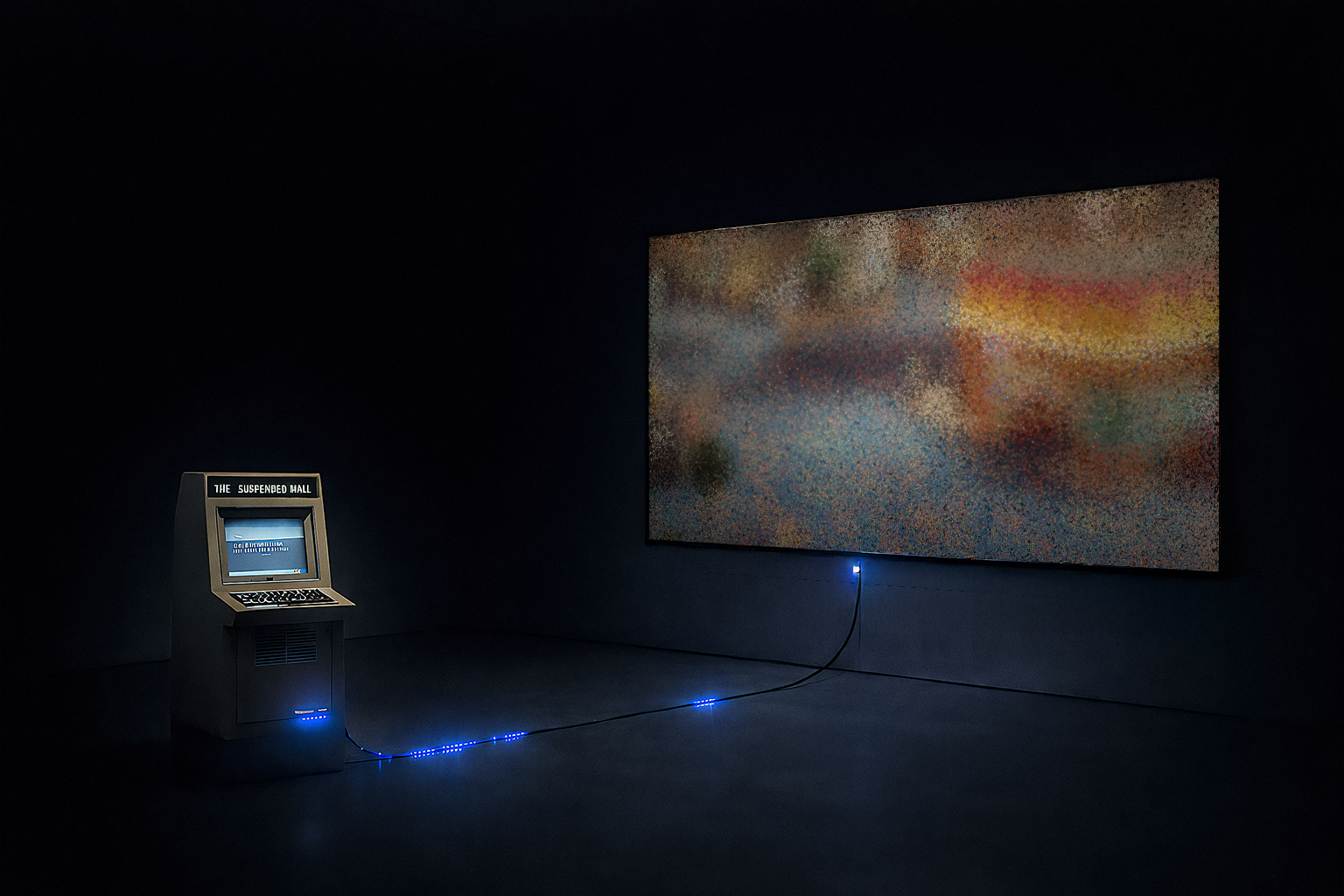
At rest, the mall appears in an unstable, incomplete state:
colors are muted and low-saturation
It’s hard to tell what space this is—everything breaks apart into scattered particles.
Input: Signals That Feed the Mall
The mall responds to two categories of input.
Both represent contemporary acceleration, but at different scales.
2.1 Live Data Input
A) Language-Based Acceleration Signals
The system tracks public language specifically related to speed, overload, and technological pace, not general sentiment.
These signals are captured only at the pattern level (frequency and density over time), using sources such as Google Trends and other public indices.
This language reflects how people collectively describe living inside acceleration, especially in relation to technology and rapid change.
B) News-Based Acceleration Signals
The system also monitors high-impact news events that indicate sudden shifts in the present.
These include, for example:
major technological breakthroughs or announcements
widely disruptive policy changes or political events
The system treats the occurrence, timing, and intensity of attention as signals.
Effect of Live Data Input:
Live data input controls the structural foundation of the mall:
floors
walls
architectural coherence
In simple terms:
Live data determines whether the mall itself can hold together as a space.
2.2 Audience-Typed Input (Personal Acceleration)
Visitors are invited to answer:
“What in your life feels too fast to keep up with?”
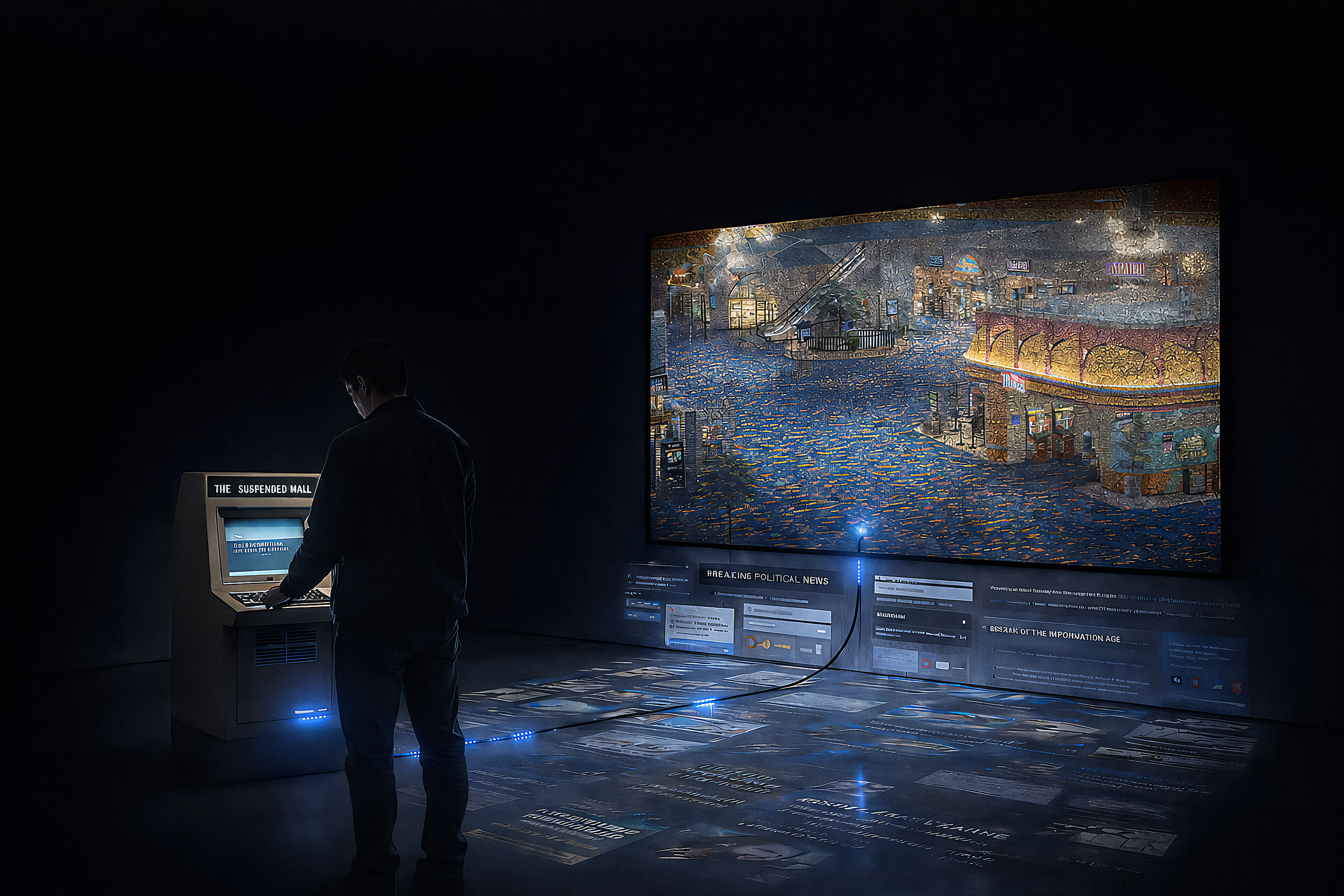
They type a short sentence on a physical terminal and submit it through a tangible action.
Effect of Audience Input:
Audience input does not affect the structure of the mall. Instead, it fills the space.
Audience input introduces:
people moving through the space
illuminated storefronts
signage, advertisements, and displays
small everyday objects:
tables
chairs
clocks
toys
decorative items
These elements are warm, ordinary, and familiar—never spectacular.
In simple terms:
Audience input determines what exists inside the mall.
2.3 Logic diagram
The world feels fasterand more unstable
↓
Acceleration signals increase
↓
Acceleration breeds nostalgia; the mall stabilizes and stages a return to life
↓
Signals fade
↓
The mall slowly dissolves
3. Media & Form
The system described above is materialized through four clearly defined media components, each corresponding directly to a specific part of the input–output mechanism.
3.1 Main Screen — The Mall Environment
A large wall-mounted screen displays the digital mall environment.
In short, the main screen shows the current state of the nostalgic world.
3.2 Physical Input Terminal — Audience Interface
A standing physical terminal with a retro, nostalgic enclosure houses a real touchscreen.
Visitors type their response to the prompt and submit it through a tangible physical action.
3.3 Visible Data Layer — Live Data Projection
Live data activity is visualized through a floor projection near the installation.
The projection shows:
abstracted indicators of incoming data
timestamps, pulses, or intensity markers
This layer exists to make clear that: the environment is being continuously fed by external signals beyond the gallery.
3.4 Connecting Cable — Data Transmission
The cable is paired with an LED strip.
When new data enters the system, the strip triggers a flowing light effect along the cable toward the main screen.
This element reinforces the sense that information is not abstract
4. Audio Experience
Sound in this project mirrors the state of the digital environment and never operates independently.
In its unstable state, the space is accompanied only by faint ambient tones, reinforcing a sense of suspension. As the nostalgic mall environment stabilizes, a soft layer of audio fades in, drawing from late-1990s to early-2000s sources such as distant television textures, advertising ambience, and gentle mall background music.
When interior content appears, subtle signs of human presence and everyday interior noise are introduced. Throughout, the audio remains restrained, reinforcing warmth and familiarity without drawing attention to itself.